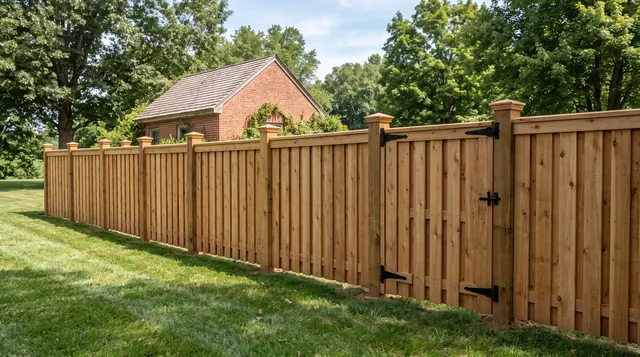
Charlottesville Fence & Gate offers fence and gate installation in Louisa, VA, managing the work through fully licensed and insured contractors. Tell us what needs to change, then we can plan the route, material and openings around that purpose.
Start with the property, not just the panel
Louisa County identifies the Town of Louisa as its county seat. For fence planning, establish whether the parcel is in the town or the surrounding county before applying a general county FAQ to the project.
A statement about ordinary county fencing does not answer every pool, retaining-wall, easement or private-covenant question. Describe the use and any special property conditions when asking which review applies.
When replacing a Louisa yard fence, compare the existing route with the area you actually need enclosed. A changed line can improve the gate location, but it can also introduce different buried-service or boundary questions. Put those changes on the drawing.
A layout decision to compare
Consider a reduced replacement route around the usable yard. This is a planning example, not a claim about a completed customer job. The old perimeter extends behind an area the household no longer uses. Compare a shorter functional enclosure with replacement on the whole line, keeping the equipment opening. Establish the new corners and private services before ordering.
Discuss your Louisa fence
Get an Estimate for Your Louisa Property. Include the address, the purpose of the enclosure and the openings you need.
Separate public approval from private requirements
Begin with the jurisdiction for the actual address. A Charlottesville mailing address does not by itself tell you that the city administers the property. Building review, zoning restrictions, visibility near an entrance and any special property conditions are separate questions. An exemption from a building permit does not necessarily settle the others.
Association covenants and architectural review also operate separately from public approval. Obtain the requirements that apply to your property and submit the actual proposed design when a review is needed. Include the material, height, route and gate locations. Approval of a neighbor's fence, or a style visible elsewhere in the neighborhood, is not approval of yours. Keep the accepted drawing with the project information so the selected system and installed route can be checked against the same description.
Locate buried services before excavation
Post holes are small excavations, but a narrow hole can still conflict with a buried service. Arrange the required utility-locate process before digging and preserve the markings while the route is reviewed. A utility marking identifies a service concern; it does not verify the property boundary or authorize a change to the fence line.
Privately owned lines need attention too. Irrigation, lighting, a service to an outbuilding or other owner-installed equipment may need a separate locating arrangement. Tell us what you know about the yard and show any available records. If a proposed post conflicts with a service, the answer may involve changing the layout or the installation method. That decision belongs before excavation, with the affected service and property requirements understood, rather than after a hole has been started.
Choose where the budget makes the biggest difference
Decide which outcome matters most before trimming the scope. Screening a patio, enclosing a dog area and defining a frontage are different priorities. Reducing the route can change the price while preserving the intended result; removing necessary supports or gate hardware changes the system itself.
Compare a basic finish and a more decorative arrangement on the same drawing. Ask what maintenance each will need and whether the product is readily identifiable for future replacement parts. Keep essential access in the plan. A fence that saves money by omitting the only useful equipment gate may create another expense later. The estimate conversation should make these tradeoffs visible so a lower total represents a deliberate choice about the finished work rather than an overlooked part of the project.
Follow the grade without losing the purpose
Ground level can change significantly between the ends of a fence run. A rackable system follows a slope within the limits of its particular panels. A stepped layout keeps sections level and changes elevation between them. Neither approach automatically solves every problem: stepping can leave a larger space under a panel, while racking changes the relationship between the infill and the ground.
The right choice depends on what the enclosure must do. A decorative boundary may tolerate a gap that would defeat a small-dog enclosure. A privacy screen can lose coverage when the viewer stands uphill. Review the route from both sides and include the gate area, where a moving leaf needs clearance through its entire travel. The final layout should describe these transitions rather than leave them to be improvised after the posts are installed.
Screening changes views and structural loading
Privacy depends on the pattern as well as the material. Closely arranged boards or solid infill reduce sight lines. Spaced pickets and shadowbox arrangements can leave angled views, particularly when someone stands near the fence. Compare the view from the patio, nearby windows and higher ground before deciding how much screening the design provides.
Solid infill also changes the way wind acts on the fence. Adding slats, fabric or panels to an open system can increase the load on posts and connections. An existing fence that performs adequately without screening is not automatically suitable for the added surface. Choose a system designed for the intended arrangement and exposure. The estimate should describe the infill, supports and any transitions so the appearance decision is carried through into the installation specification.
Fence systems and access options
Compare wood, vinyl, aluminum and chain link for the yard. Gates belong in the initial layout. Horse fencing, commercial work and temporary construction enclosures have separate planning scopes.
How we handle a Louisa project
Send the exact Louisa address and photos from the entrance to the proposed line. We review the intended use, any retained fencing and the approach for installation. Identify the documents and review process for the Town of Louisa and Louisa County, along with any private requirements. The written scope brings those decisions together before the work is scheduled.
Questions about fencing in Louisa
Does a general county FAQ settle a pool-fence request?
No. Pool use, retaining features, easements and private requirements can introduce separate review questions. Describe those conditions when asking about the fence.
Can replacement follow a shorter route?
Compare the usable yard with the original perimeter, then establish the new corners and access. A shorter layout still needs its own boundary and utility review.
Which parts of the scope should I settle first?
For a reduced replacement route around the usable yard, begin with the purpose, proposed line and the access it needs. Compare the drawing with your boundary documents before choosing the final system.
What does residential fencing cost here?
Use a Charlottesville-area starting range of about $20 to $45 per linear foot for residential installation. Gates, removal and difficult site work add to the total. A commercial, equestrian or temporary-fencing project needs its own scope rather than the residential range.
Can I include a gate and existing-fence removal?
Yes. Mark the opening and the sections to remove on the Louisa sketch. Specify what needs to pass through the gate, and ask for retained posts or concrete footings to be identified in the estimate.
Nearby service areas
- Fence Installation in Gordonsville, VA
- Fence Installation in Orange, VA
- Fence Installation in Palmyra, VA
Plan the next step
- Fence planning guide for the Charlottesville area
- Fence installation cost in the Charlottesville area
- Fence utility locates and easements
Get an Estimate for Your Louisa Fence. Send the location, approximate route and what you need the finished work to do.