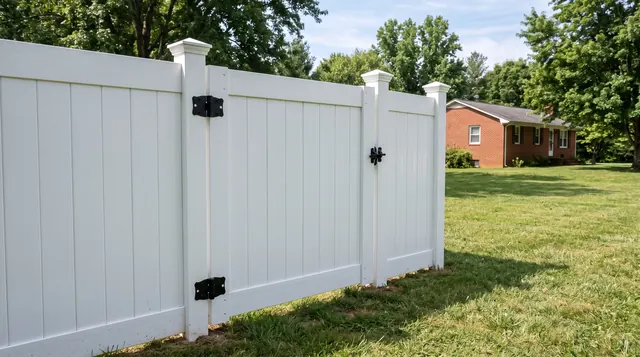
Charlottesville Fence & Gate offers fence and gate installation in Scottsville, VA, managing the work through fully licensed and insured contractors. Tell us what needs to change, then we can plan the route, material and openings around that purpose.
Start with the property, not just the panel
Scottsville has a direct relationship with the James River, including public access near Main Street. That geography makes parcel-specific floodplain and drainage review relevant where the proposed fence is affected. It does not establish that every Scottsville property is in a floodplain.
Confirm whether the address is in the town or surrounding county before applying a fence rule. Keep public frontage, private boundary and any recorded access separate on the layout drawing. A familiar town mailing address does not settle each question.
A downtown frontage and a more open property outside the center can need different access planning. Show the route from the street to the actual work, and identify any shared passage. A fence should not obstruct a needed water path or be used as a retaining feature.
A layout decision to compare
Consider a replacement with a constrained street-to-yard route. This is a planning example, not a claim about a completed customer job. The fence at the back can be reached only through a side passage. Define removal and material handling before choosing the new panels. If mapping identifies a floodplain or another special property condition, resolve that review before the route is treated as accepted.
Discuss your Scottsville fence
Get an Estimate for Your Scottsville Property. Include the address, the purpose of the enclosure and the openings you need.
Keep water and ground conditions in the plan
A fence is not a retaining wall or a drainage system. Soil should not be piled against ordinary panels to close a gap, and a solid lower edge should not be used to dam a flow path without appropriate design. Tell us where water crosses the proposed route and show the area after wet weather if you have useful photographs.
Persistent wetness can affect excavation, wood exposure and access for installation. A photograph of standing water does not establish the cause or specify a footing. The work may need a changed route, different materials or separate help with the drainage problem. Where a fence meets a retaining feature, the loads and attachment arrangement need their own review. Keep those responsibilities explicit so a fence estimate does not quietly become a promise to solve unrelated ground or wall movement.
Establish the route before placing the posts
A fence marks the line where it is built; it does not establish the legal property boundary. Start with the survey or plat and any recorded documents affecting the route. An old fence may have been placed inside the property, moved around a tree or built with a neighbor's informal agreement. A line on a public mapping website is useful for orientation, but it is not a substitute for resolving an uncertain boundary.
Identify the corners before ordering sections. If the route changes after the posts are set, the correction can involve more than moving a few boards. Gates, panel lengths and the appearance of the return all depend on those positions. Tell us about disputed or missing markers early so that the installation layout can wait for the right boundary evidence.
Screening changes views and structural loading
Privacy depends on the pattern as well as the material. Closely arranged boards or solid infill reduce sight lines. Spaced pickets and shadowbox arrangements can leave angled views, particularly when someone stands near the fence. Compare the view from the patio, nearby windows and higher ground before deciding how much screening the design provides.
Solid infill also changes the way wind acts on the fence. Adding slats, fabric or panels to an open system can increase the load on posts and connections. An existing fence that performs adequately without screening is not automatically suitable for the added surface. Choose a system designed for the intended arrangement and exposure. The estimate should describe the infill, supports and any transitions so the appearance decision is carried through into the installation specification.
Decide what comes out and what can remain
Replacement starts with a condition and layout review of the existing fence. Some components may be sound while others have deteriorated, moved or become incompatible with the proposed design. Reusing posts can affect panel spacing and gate positions, so it is a decision to document rather than an automatic saving to promise.
Identify the removal limits on the sketch. Does the work stop at a shared corner? Are concrete footings coming out, or does the new line avoid them? What remains attached to the neighbor's section? The removal method should protect components that are staying and account for the condition of the old materials. If the fence contains a dog or separates an occupied work area, agree on how the opening will be managed while the old run is down. An incomplete enclosure should not be treated as secure.
Put the walk gate on the route people use
An everyday gate should connect useful places: the back door and path, the driveway and yard, or the garden and tool storage. A convenient position reduces the temptation to leave the opening unsecured. Check the space with the leaf open as well as closed so it does not occupy the only standing room or catch on planting.
Plan for the things people carry or push through. A clear opening that works for walking may not accommodate a wheelbarrow or mower. Hinges, stops and the latch need to suit the frame and the intended use. Do not rely on a residential yard-gate detail for a swimming-pool barrier; that use has separate requirements for the complete barrier and gate arrangement. Explain the purpose at the start so the chosen opening is appropriate before the fence line is fixed.
Fence systems and access options
Compare wood, vinyl, aluminum and chain link for the yard. Gates belong in the initial layout. Horse fencing, commercial work and temporary construction enclosures have separate planning scopes.
How we handle a Scottsville project
Send the exact Scottsville address and photos from the entrance to the proposed line. We review the intended use, any retained fencing and the approach for installation. Identify the documents and review process for the Town of Scottsville and the responsible county, along with any private requirements. The written scope brings those decisions together before the work is scheduled.
Questions about fencing in Scottsville
Does a Scottsville address prove the property is in a floodplain?
No. Check the actual parcel and proposed route. River geography is a reason to review the question, not a conclusion about every property.
What if removal can only happen through a narrow side passage?
Show that route and the retained features. Handling and excavation methods need to fit the available access before large replacement sections are selected.
Which parts of the scope should I settle first?
For a replacement with a constrained street-to-yard route, begin with the purpose, proposed line and the access it needs. Compare the drawing with your boundary documents before choosing the final system.
What does residential fencing cost here?
Use a Charlottesville-area starting range of about $20 to $45 per linear foot for residential installation. Gates, removal and difficult site work add to the total. A commercial, equestrian or temporary-fencing project needs its own scope rather than the residential range.
Can I include a gate and existing-fence removal?
Yes. Mark the opening and the sections to remove on the Scottsville sketch. Specify what needs to pass through the gate, and ask for retained posts or concrete footings to be identified in the estimate.
Nearby service areas
- Fence Installation in Lake Monticello, VA
- Fence Installation in Rivanna, VA
- Fence Installation in Pantops, VA
Plan the next step
- Fence planning guide for the Charlottesville area
- Fence installation cost in the Charlottesville area
- Fence utility locates and easements
Get an Estimate for Your Scottsville Fence. Send the location, approximate route and what you need the finished work to do.