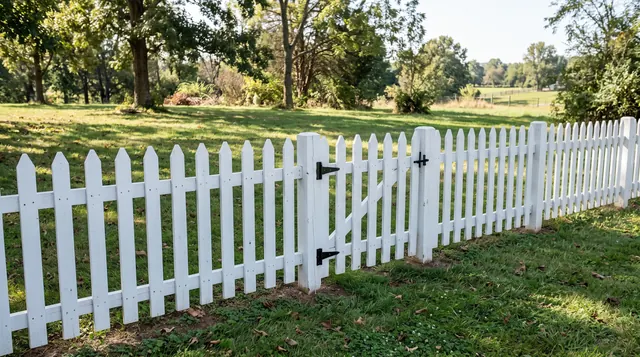
Charlottesville Fence & Gate offers fence and gate installation in Madison, VA, managing the work through fully licensed and insured contractors. Tell us what needs to change, then we can plan the route, material and openings around that purpose.
Start with the property, not just the panel
Madison County’s planning and building offices provide separate starting points for property questions. Confirm whether the address is subject to town administration as well, rather than assuming the postal name settles the jurisdiction.
A larger Madison property may need a yard enclosure, a visible boundary or an equestrian system. Those are different jobs. The route should identify where people, animals and equipment move before material quantities are calculated.
For a horse or equipment entrance, show the approach beyond the gate posts. A tractor or trailer needs more than its straight-line width. Include any private services crossing the line and keep horse containment separate from a decorative rail frontage.
A layout decision to compare
Consider a yard fence connected to a separate field entrance. This is a planning example, not a claim about a completed customer job. The house needs a practical pet enclosure while the field entrance remains available for equipment. Draw each function and its transition. If horses use the field, select the enclosure for those animals rather than assuming that an open residential rail is appropriate.
Discuss your Madison fence
Get an Estimate for Your Madison Property. Include the address, the purpose of the enclosure and the openings you need.
Distinguish an open boundary from an animal enclosure
Split-rail and ranch-rail designs create a visible boundary with substantial open space between rails. That openness may be exactly what you want along a frontage or garden edge. It does not make the same assembly suitable for containing a dog or horse without further design decisions.
Adding mesh is a system choice, not merely an accessory to mention at the end. Mesh opening, attachment and the ground transition need to suit the intended animal and the support arrangement. A decorative residential rail should not be described as horse containment simply because the finished fence looks similar from a distance. Define the job first, then select the rail, mesh and gate details that can do it. The accepted drawing should show where open boundary sections change to enclosed sections.
Check the vehicle approach before choosing the gate
The width of a vehicle is only one part of a driveway-gate plan. A trailer may need to turn before reaching the opening, and the driver needs space to wait while the gate is opened. Show the approach, public-road connection and any place vehicles regularly park. Do not assume the road shoulder can serve as a waiting area.
A swing gate needs a clear arc on the property and suitable ground beneath it. A sliding system needs room for the leaf to travel beside the opening and supports appropriate to that system. A double swing can divide the span between leaves, but it still needs a closing arrangement and suitable posts. Manual access is the scope discussed here. Powered operation introduces a separate safety, equipment and electrical design; it is not included by choosing a gate that might later accept an operator.
Plan for wood movement and future maintenance
Wood responds to moisture and exposure. Boards can change shape or spacing as they dry, and a finish does not stop every dimensional change. The selected board pattern and fastening method need to accommodate the material rather than assume that each board will remain exactly as delivered.
Staining or sealing is a separate scope unless it is included explicitly. Product instructions govern surface preparation and the condition the wood needs to be in before application. Keep soil, piled leaves and persistent plant contact away from the fence where practical, and watch the areas around posts and lower rails. When comparing designs, consider how you will reach both faces for inspection and maintenance. A fence tucked tightly behind a hedge may be difficult to care for even if the first installation is straightforward.
Establish the route before placing the posts
A fence marks the line where it is built; it does not establish the legal property boundary. Start with the survey or plat and any recorded documents affecting the route. An old fence may have been placed inside the property, moved around a tree or built with a neighbor's informal agreement. A line on a public mapping website is useful for orientation, but it is not a substitute for resolving an uncertain boundary.
Identify the corners before ordering sections. If the route changes after the posts are set, the correction can involve more than moving a few boards. Gates, panel lengths and the appearance of the return all depend on those positions. Tell us about disputed or missing markers early so that the installation layout can wait for the right boundary evidence.
Follow the grade without losing the purpose
Ground level can change significantly between the ends of a fence run. A rackable system follows a slope within the limits of its particular panels. A stepped layout keeps sections level and changes elevation between them. Neither approach automatically solves every problem: stepping can leave a larger space under a panel, while racking changes the relationship between the infill and the ground.
The right choice depends on what the enclosure must do. A decorative boundary may tolerate a gap that would defeat a small-dog enclosure. A privacy screen can lose coverage when the viewer stands uphill. Review the route from both sides and include the gate area, where a moving leaf needs clearance through its entire travel. The final layout should describe these transitions rather than leave them to be improvised after the posts are installed.
Fence systems and access options
Compare wood, vinyl, aluminum and chain link for the yard. Gates belong in the initial layout. Horse fencing, commercial work and temporary construction enclosures have separate planning scopes.
How we handle a Madison project
Send the exact Madison address and photos from the entrance to the proposed line. We review the intended use, any retained fencing and the approach for installation. Identify the documents and review process for the Town of Madison and Madison County, along with any private requirements. The written scope brings those decisions together before the work is scheduled.
Questions about fencing in Madison
Can one fence serve the house and a horse field?
The sections can be planned together, but their functions must remain clear. Pet containment, decorative frontage and equestrian use need appropriate systems at each transition.
What should I include for trailer access?
Show the approach and turning movement as well as the clear opening. A vehicle’s width when parked straight ahead is not enough to plan the entrance.
Which parts of the scope should I settle first?
For a yard fence connected to a separate field entrance, begin with the purpose, proposed line and the access it needs. Compare the drawing with your boundary documents before choosing the final system.
What does residential fencing cost here?
Use a Charlottesville-area starting range of about $20 to $45 per linear foot for residential installation. Gates, removal and difficult site work add to the total. A commercial, equestrian or temporary-fencing project needs its own scope rather than the residential range.
Can I include a gate and existing-fence removal?
Yes. Mark the opening and the sections to remove on the Madison sketch. Specify what needs to pass through the gate, and ask for retained posts or concrete footings to be identified in the estimate.
Nearby service areas
- Fence Installation in Ruckersville, VA
- Fence Installation in Stanardsville, VA
- Fence Installation in Orange, VA
Plan the next step
- Fence planning guide for the Charlottesville area
- Fence installation cost in the Charlottesville area
- Fence utility locates and easements
Get an Estimate for Your Madison Fence. Send the location, approximate route and what you need the finished work to do.