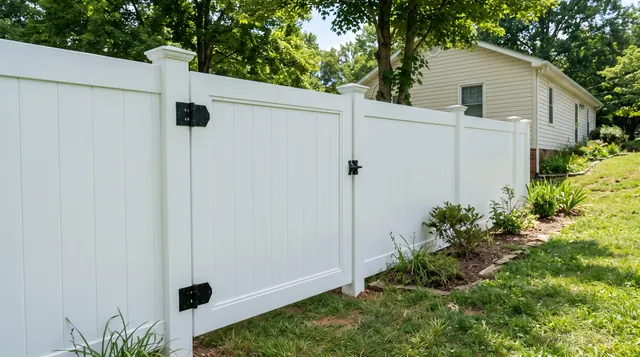
Charlottesville Fence & Gate offers fence and gate installation in Lovingston, VA, managing the work through fully licensed and insured contractors. Tell us what needs to change, then we can plan the route, material and openings around that purpose.
Start with the property, not just the panel
Lovingston is Nelson County’s seat on the Route 29 corridor, with a walkable historic center. A street-front fence and an enclosure beyond that center should be planned from their actual setting rather than given one uniform design.
Where appearance or a special district may affect the frontage, identify the applicable review before choosing the material. The fact that a building is near the historic center does not by itself establish its individual restrictions.
At a property reached from a smaller side entrance, show where deliveries can enter and materials can be staged. Preserve the route people use on foot and keep a moving gate from occupying the only practical standing area.
A layout decision to compare
Consider a small frontage with a separate private sitting area. This is a planning example, not a claim about a completed customer job. The house needs an open edge toward the street and more screening beside the patio. Compare a short privacy return with an open picket section, then review the corner and gate. The accepted scope should make clear which area each design serves.
Discuss your Lovingston fence
Get an Estimate for Your Lovingston Property. Include the address, the purpose of the enclosure and the openings you need.
Set the frontage and the everyday opening
A picket fence defines an edge through its posts, rails and individual upright members. Picket shape, spacing and top profile influence the appearance, but the location of the line often matters more to everyday use. Leave room for the path, planting and the gate swing you need rather than treating the property edge as an automatic installation route.
Street-facing work needs a review of visibility and the public right-of-way. A low decorative fence can still be poorly placed near a driveway or corner. An existing hedge, sidewalk edge or mowing line is not reliable proof of the legal boundary. If the picket fence is also expected to contain an animal, evaluate the openings and ground gaps separately. The attractive front elevation and the functional enclosure should be part of the same accepted plan.
Check privacy from where you spend time
Stand where the fence needs to make a difference. The view from a seated patio is different from the view through an upstairs window, and higher ground can look over a screen that appears solid at eye level. Mark the area you want screened rather than treating the entire property perimeter as the only possible route.
A short privacy return can sometimes address a specific view without enclosing every edge. An open side boundary may preserve a view you want to keep. These are layout options to compare, not promises that a particular height will solve the issue. The accepted design must also account for local and private restrictions. Show nearby trees, planting beds and utility equipment so the desired screen can be placed without turning an appearance decision into a conflict with access or maintenance.
Match containment to the dog and the route
A dog enclosure needs more than a stated fence height. Look at openings below the fence, spaces beside posts, changes in grade and the gap at a closed gate. A small dog, a climber and a dog that pushes against the bottom present different questions. Describe the behavior you are trying to address without assuming that one material makes every yard secure.
Check the entire enclosure, including where a new section meets the house, an old fence or a retaining feature. A long sound run can still be defeated by one awkward transition. Plan how the dog stays separated from the work area during removal and installation, and do not rely on an unfinished fence for containment. Gates need an everyday closing routine that the household can actually follow. No fence eliminates the need to supervise animals and maintain the enclosure.
Specify the fabric, framework and tensioning
Chain link is a system of mesh fabric supported by posts and rails or other specified members. Fabric gauge, mesh opening, coating and height affect what is being installed. Terminal posts at ends, corners and gates have different responsibilities from line posts supporting the intervening fabric.
Tension bars, bands, ties and any specified tension wire connect and stabilize the fabric. Tension wire is not a substitute for sound posts or the rest of the required framework. An estimate should identify the complete system rather than offer a length of mesh with undefined supports. If privacy slats or screening are proposed, include them at the design stage because they change the wind exposure of the fence. For an existing post line, condition, alignment and compatibility must be assessed before reuse is included.
Screening changes views and structural loading
Privacy depends on the pattern as well as the material. Closely arranged boards or solid infill reduce sight lines. Spaced pickets and shadowbox arrangements can leave angled views, particularly when someone stands near the fence. Compare the view from the patio, nearby windows and higher ground before deciding how much screening the design provides.
Solid infill also changes the way wind acts on the fence. Adding slats, fabric or panels to an open system can increase the load on posts and connections. An existing fence that performs adequately without screening is not automatically suitable for the added surface. Choose a system designed for the intended arrangement and exposure. The estimate should describe the infill, supports and any transitions so the appearance decision is carried through into the installation specification.
Fence systems and access options
Compare wood, vinyl, aluminum and chain link for the yard. Gates belong in the initial layout. Horse fencing, commercial work and temporary construction enclosures have separate planning scopes.
How we handle a Lovingston project
Send the exact Lovingston address and photos from the entrance to the proposed line. We review the intended use, any retained fencing and the approach for installation. Identify the documents and review process for Nelson County, along with any private requirements. The written scope brings those decisions together before the work is scheduled.
Questions about fencing in Lovingston
Does proximity to the historic center establish special restrictions?
No automatic conclusion follows. Identify any designation and review requirements for the actual property before choosing a frontage design.
Can the patio be screened while the frontage stays open?
Compare a short privacy return with an open street-facing section. Design the junction and useful gate route so each part serves its intended purpose.
Which parts of the scope should I settle first?
For a small frontage with a separate private sitting area, begin with the purpose, proposed line and the access it needs. Compare the drawing with your boundary documents before choosing the final system.
What does residential fencing cost here?
Use a Charlottesville-area starting range of about $20 to $45 per linear foot for residential installation. Gates, removal and difficult site work add to the total. A commercial, equestrian or temporary-fencing project needs its own scope rather than the residential range.
Can I include a gate and existing-fence removal?
Yes. Mark the opening and the sections to remove on the Lovingston sketch. Specify what needs to pass through the gate, and ask for retained posts or concrete footings to be identified in the estimate.
Nearby service areas
- Fence Installation in Nellysford, VA
- Fence Installation in Afton, VA
- Fence Installation in Waynesboro, VA
Plan the next step
- Fence planning guide for the Charlottesville area
- Fence installation cost in the Charlottesville area
- Fence utility locates and easements
Get an Estimate for Your Lovingston Fence. Send the location, approximate route and what you need the finished work to do.