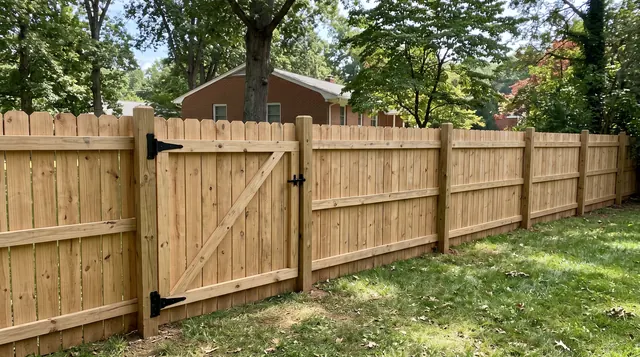
Follow the wood and finish product instructions, keep prolonged moisture and debris away where practical, and address loose or deteriorated components. Staining and sealing require suitable preparation and wood condition. A coating does not correct rot, insect damage or an unstable post.
Charlottesville Fence & Gate helps property owners plan fence and gate work across the Charlottesville area, with installation managed through fully licensed and insured contractors.
The decision to work through
Weathering can change the color and surface appearance without proving that a board has lost its function. Soft wood, loose attachments or changes in alignment deserve closer review. Termite activity and moisture-related deterioration require appropriate assessment; a photograph alone does not establish the cause. Avoid covering a defect with a finish and assuming the underlying component is restored.
Plan for wood movement and future maintenance
Wood responds to moisture and exposure. Boards can change shape or spacing as they dry, and a finish does not stop every dimensional change. The selected board pattern and fastening method need to accommodate the material rather than assume that each board will remain exactly as delivered.
Staining or sealing is a separate scope unless it is included explicitly. Product instructions govern surface preparation and the condition the wood needs to be in before application. Keep soil, piled leaves and persistent plant contact away from the fence where practical, and watch the areas around posts and lower rails. When comparing designs, consider how you will reach both faces for inspection and maintenance. A fence tucked tightly behind a hedge may be difficult to care for even if the first installation is straightforward.
Choose the wood and the board arrangement together
Pressure-treated pine and cedar are different material choices, not interchangeable labels for the same board. Treatment, grade, moisture condition and the intended use matter. Wood in contact with the ground needs the appropriate specification, and exterior fasteners must be compatible with the wood and any treatment. Ask for those details instead of comparing a price that says only wood fence.
The board pattern changes the result too. Board-on-board overlaps pickets to reduce direct gaps. A shadowbox alternates boards across the rails and gives a different appearance from each viewing angle. Stockade describes a close-board arrangement; a lattice-top design adds an upper element that needs its own support and overall-height review. Cedar or redwood availability, grade and suitability should be checked before a particular species is put into the accepted scope.
Bring the plan into focus
Get an Estimate. Send the address, photos and the question you are trying to resolve.
Keep water and ground conditions in the plan
A fence is not a retaining wall or a drainage system. Soil should not be piled against ordinary panels to close a gap, and a solid lower edge should not be used to dam a flow path without appropriate design. Tell us where water crosses the proposed route and show the area after wet weather if you have useful photographs.
Persistent wetness can affect excavation, wood exposure and access for installation. A photograph of standing water does not establish the cause or specify a footing. The work may need a changed route, different materials or separate help with the drainage problem. Where a fence meets a retaining feature, the loads and attachment arrangement need their own review. Keep those responsibilities explicit so a fence estimate does not quietly become a promise to solve unrelated ground or wall movement.
A symptom is a starting point, not a diagnosis
A leaning post, dragging gate or damaged panel can have several causes. The visible problem may be local, or it may reflect movement in supports that affects adjoining sections. Replacing the most obvious piece without reviewing the connections can leave the underlying issue in place.
Describe what changed and when you noticed it. Photos of the whole run, the supports and the ground are more useful than one close-up alone. A repair decision depends on the condition of the retained system and whether compatible parts are available. Replacement may make more sense when the material or layout no longer serves the property. Until a damaged enclosure is addressed, use another appropriate means of containing pets or separating access. Do not push or climb a loose section to test its strength.
Keep a useful record of the finished scope
Keep the accepted route drawing, product identification and description of retained components together. If maintenance instructions are supplied for a finish or gate system, store them with that record. A future damaged-panel inquiry is easier to assess when the material and profile can be identified.
Photograph the completed line and gate arrangement for your own records. Do not use a photograph as a substitute for a survey or approval document; it records appearance, not the legal boundary. Note which old footings were removed and which were left in place if that was part of the scope. When later landscaping or building work is planned, that information can help explain what is already underground and what should be reviewed before the fence is altered.
Sun exposure and surface weathering
UV exposure contributes to fading and surface weathering in wood. A color change is different from loss of structural soundness, while rot or termite damage can require a component-level assessment. Cleaning or refinishing should follow the finish and wood instructions. Do not stain over softened or visibly deteriorated wood and treat the appearance improvement as restoration of the damaged component.
Questions before you decide
What information is most useful at the start?
The address, proposed route, intended purpose and photos help define the question. Add the product information or existing-fence details when you have them.
Can a photograph settle the whole scope?
Photos help with the first discussion, but they do not establish hidden conditions, boundaries or approval. Keep those questions separate from the appearance of the fence.
What is the next step?
Choose the outcome you need, identify the unresolved decisions and request an estimate with that information. The written scope should describe the system and work before installation.
Related service and guides
- Wood Fence Installation in Charlottesville, VA
- Fence planning guide for the Charlottesville area
- Fence installation cost in the Charlottesville area
- Survey before fence installation
- What happens during fence installation
Get an Estimate. Tell us where the property is and what needs to change.