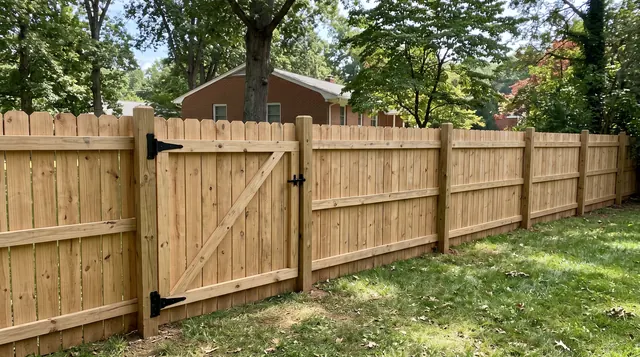
Choose according to the boundary you need. Chain link provides an open mesh enclosure; wood can provide a screen or a more open board pattern. Compare containment, views, gates and maintenance before choosing by material price alone.
Charlottesville Fence & Gate helps property owners plan fence and gate work across the Charlottesville area, with installation managed through fully licensed and insured contractors.
The decision to work through
A dog enclosure and a private patio are different decisions. Mesh can keep sight lines open, while close-board wood can interrupt them. Adding screening to chain link changes its loading and should be included in the design. A shared corner or existing post line also needs compatibility review whichever material you choose.
Specify the fabric, framework and tensioning
Chain link is a system of mesh fabric supported by posts and rails or other specified members. Fabric gauge, mesh opening, coating and height affect what is being installed. Terminal posts at ends, corners and gates have different responsibilities from line posts supporting the intervening fabric.
Tension bars, bands, ties and any specified tension wire connect and stabilize the fabric. Tension wire is not a substitute for sound posts or the rest of the required framework. An estimate should identify the complete system rather than offer a length of mesh with undefined supports. If privacy slats or screening are proposed, include them at the design stage because they change the wind exposure of the fence. For an existing post line, condition, alignment and compatibility must be assessed before reuse is included.
Choose the wood and the board arrangement together
Pressure-treated pine and cedar are different material choices, not interchangeable labels for the same board. Treatment, grade, moisture condition and the intended use matter. Wood in contact with the ground needs the appropriate specification, and exterior fasteners must be compatible with the wood and any treatment. Ask for those details instead of comparing a price that says only wood fence.
The board pattern changes the result too. Board-on-board overlaps pickets to reduce direct gaps. A shadowbox alternates boards across the rails and gives a different appearance from each viewing angle. Stockade describes a close-board arrangement; a lattice-top design adds an upper element that needs its own support and overall-height review. Cedar or redwood availability, grade and suitability should be checked before a particular species is put into the accepted scope.
Bring the plan into focus
Get an Estimate. Send the address, photos and the question you are trying to resolve.
Match containment to the dog and the route
A dog enclosure needs more than a stated fence height. Look at openings below the fence, spaces beside posts, changes in grade and the gap at a closed gate. A small dog, a climber and a dog that pushes against the bottom present different questions. Describe the behavior you are trying to address without assuming that one material makes every yard secure.
Check the entire enclosure, including where a new section meets the house, an old fence or a retaining feature. A long sound run can still be defeated by one awkward transition. Plan how the dog stays separated from the work area during removal and installation, and do not rely on an unfinished fence for containment. Gates need an everyday closing routine that the household can actually follow. No fence eliminates the need to supervise animals and maintain the enclosure.
Screening changes views and structural loading
Privacy depends on the pattern as well as the material. Closely arranged boards or solid infill reduce sight lines. Spaced pickets and shadowbox arrangements can leave angled views, particularly when someone stands near the fence. Compare the view from the patio, nearby windows and higher ground before deciding how much screening the design provides.
Solid infill also changes the way wind acts on the fence. Adding slats, fabric or panels to an open system can increase the load on posts and connections. An existing fence that performs adequately without screening is not automatically suitable for the added surface. Choose a system designed for the intended arrangement and exposure. The estimate should describe the infill, supports and any transitions so the appearance decision is carried through into the installation specification.
Plan for wood movement and future maintenance
Wood responds to moisture and exposure. Boards can change shape or spacing as they dry, and a finish does not stop every dimensional change. The selected board pattern and fastening method need to accommodate the material rather than assume that each board will remain exactly as delivered.
Staining or sealing is a separate scope unless it is included explicitly. Product instructions govern surface preparation and the condition the wood needs to be in before application. Keep soil, piled leaves and persistent plant contact away from the fence where practical, and watch the areas around posts and lower rails. When comparing designs, consider how you will reach both faces for inspection and maintenance. A fence tucked tightly behind a hedge may be difficult to care for even if the first installation is straightforward.
Questions before you decide
What information is most useful at the start?
The address, proposed route, intended purpose and photos help define the question. Add the product information or existing-fence details when you have them.
Can a photograph settle the whole scope?
Photos help with the first discussion, but they do not establish hidden conditions, boundaries or approval. Keep those questions separate from the appearance of the fence.
What is the next step?
Choose the outcome you need, identify the unresolved decisions and request an estimate with that information. The written scope should describe the system and work before installation.
Related service and guides
- Chain Link Fence Installation in Charlottesville, VA
- Fence planning guide for the Charlottesville area
- Fence installation cost in the Charlottesville area
- Survey before fence installation
- What happens during fence installation
Get an Estimate. Tell us where the property is and what needs to change.